LinkedIn Ghostwriting: How to Manage Multiple Clients Without Voice Bleed

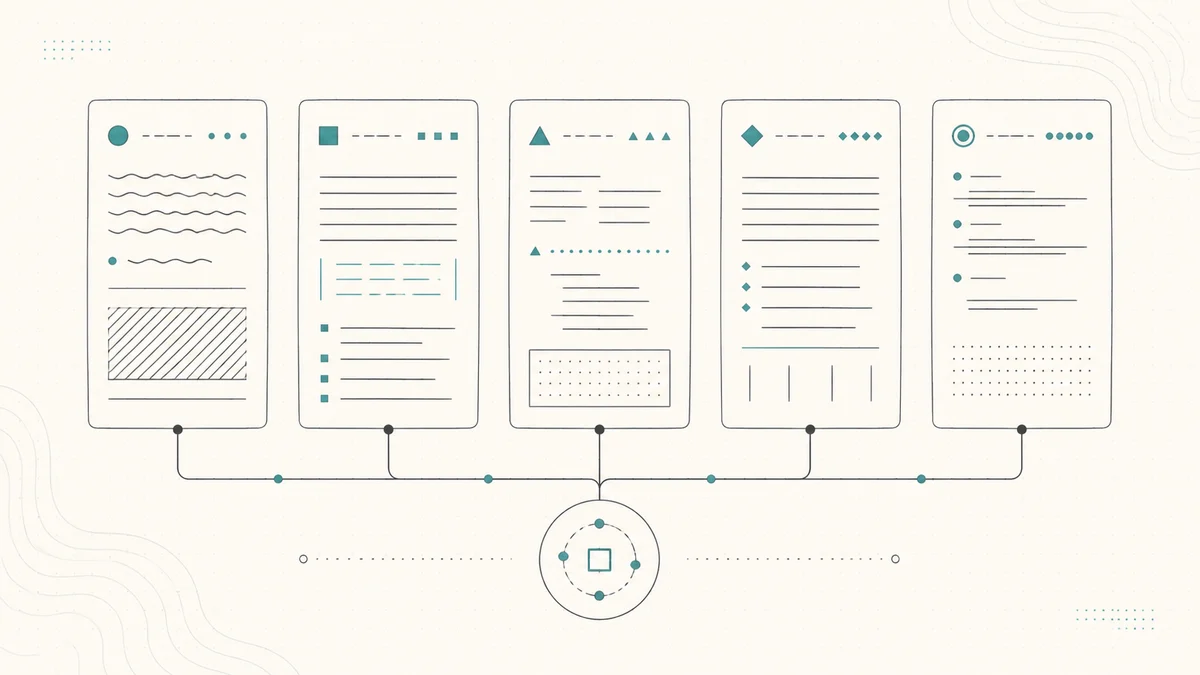
LinkedIn ghostwriting is easy to manage when you write for two clients.
One is blunt. One is reflective. You remember how each person talks, which stories belong to whom, and the phrases they would never use.
Then the roster grows.
You write a sharp one-line hook for the blunt founder on Monday. On Tuesday, a softer version of the same hook appears in the coach's draft. By Friday, three clients are ending posts with the same question. Nothing is obviously wrong, but the voices are starting to converge.
That is voice bleed. It is not a talent problem. It is what happens when a ghostwriter tries to hold several people in memory without a system designed to keep them separate.
A good LinkedIn ghostwriting workflow should do more than track deadlines. It should preserve the thing each client is paying you to protect: the sense that a real, distinct person is behind every post.
This guide shows how to build that workflow, from source material and voice capture to drafting, approval, and revision learning.
TL;DR
- A content calendar cannot prevent voice bleed. It tracks when a post is due, not who should be speaking.
- Capture behaviors, not adjectives. "Professional" and "authentic" are too vague. Sentence shape, vocabulary, emotional range, and argument patterns are usable.
- Keep every client's context separate. Source material, voice rules, drafts, approvals, and revision history should never share one undifferentiated workspace.
- Extract the point of view before drafting. Voice without a real opinion produces polished imitation.
- Review idea and voice in separate passes. A draft can sound right while saying something the client does not believe.
- Turn edits into reusable rules. Client feedback should improve the system, not disappear inside one document.
- Use AI for the draft layer, not the thinking layer. It can apply a well-built voice profile, but it cannot invent the client's lived experience or private convictions.
What is LinkedIn ghostwriting?
LinkedIn ghostwriting is the work of turning another person's experience, ideas, and point of view into posts they publish under their own name.
The job is not simply to produce clean copy. A LinkedIn ghostwriter has to extract what the client genuinely thinks, protect factual and confidentiality boundaries, and write in a way the client recognizes as their own. The final post should carry the client's judgment, even though another person helped shape the words.
That becomes harder when one ghostwriter manages several clients. Each new client adds a separate body of stories, vocabulary, beliefs, sensitivities, and writing habits. Without structural separation, those voices gradually collapse into the writer's house style.
The workflow below is designed to prevent that collapse.
Why do client voices start sounding the same?
Most ghostwriters do not deliberately reuse one voice. The convergence happens through small shortcuts.
You are moving fast, so you reuse a hook shape that worked yesterday. You open the same general prompt for every client. You remember that one client likes short sentences, but forget that another uses short sentences only when making a hard argument. You rely on a tone-of-voice document written during onboarding and stop updating it after month one.
Each shortcut removes context. The draft then falls back to the strongest style still available: your own habits, your preferred structures, or the average voice produced by the writing tool.
Voice bleed usually appears in five places:
On a narrow screen, scroll sideways to read every column.
| Signal | What it looks like across clients |
|---|---|
| Hooks | Everyone opens with the same contrast, confession, or contrarian claim |
| Rhythm | Paragraphs and sentence lengths start following one repeated cadence |
| Vocabulary | The same transitions, adjectives, and favorite phrases appear everywhere |
| Point of view | Different clients begin making similarly safe, agreeable arguments |
| Endings | Every post closes with the same lesson or engagement question |
The problem becomes more visible as the roster grows, but the cause is not the number of clients by itself. The cause is missing separation.
A spreadsheet can tell you that Client B needs a post on Thursday. It cannot remind you that Client B explains ideas through stories, dislikes absolute claims, never uses rhetorical questions, and changed their position on remote work six months ago.
You need a system that brings those distinctions into the draft before your own house style takes over.
What actually makes a client's voice distinct?
Voice is often documented with labels such as:
- professional but approachable;
- confident, not arrogant;
- conversational and authentic;
- insightful and concise.
None of those descriptions is wrong. None is useful enough to guide a difficult sentence.
Two clients can both be "confident and conversational" while sounding nothing alike. One may state conclusions first and defend them with numbers. The other may enter through a personal mistake, circle the lesson, and soften every universal claim with a caveat.
A practical voice reference records observable choices. Think of it as a compact brand voice guide built for daily writing decisions rather than a presentation deck.
Sentence and paragraph shape
Does the client write in clipped statements or developed paragraphs? Do they alternate short and long sentences? Do they use fragments deliberately? How much context do they give before making the point?
Vocabulary
Which plain words do they repeat? Which technical terms do they use without explanation? Which fashionable phrases do they reject? Do they say "customers," "users," or "people"?
Argument pattern
Do they lead with a conclusion, a story, a question, or a piece of evidence? Do they sound certain or exploratory? How do they disagree without sounding unlike themselves?
Emotional range
What can this person plausibly sound excited, angry, proud, worried, or amused about? A restrained executive and an expressive coach can discuss the same result with completely different emotional volume.
Point of view
What does the client believe because of their experience? What industry advice do they reject? Where have they changed their mind? Voice is not only how a person arranges words. It is also what they repeatedly notice and how they interpret it.
Boundaries
What would they never claim, disclose, joke about, or turn into content? Which client stories are confidential? Which results need qualification? A useful voice system protects judgment and trust, not just style.
The goal is not to create a personality profile. It is to make the next writing decision easier and more accurate.
Step 1: Build a clean evidence base for each client
Start with material that genuinely belongs to the client.
Useful sources include:
- posts they wrote or heavily edited themselves;
- call transcripts where they explain their work naturally;
- emails, memos, newsletters, or comments they authored;
- approved posts with visible client revisions;
- recordings of interviews, talks, or podcasts;
- notes on stories, examples, and positions they have cleared for public use.
Treat each source according to what it can prove.
Past LinkedIn posts are useful for rhythm and public positioning. Calls often reveal vocabulary, energy, and opinions that polished posts hide. Approval edits show the boundary between language the client tolerates and language they actually recognize as theirs.
Do not quietly treat every available sample as ground truth. Some old posts may have been written by another ghostwriter. Some may reflect positioning the client has abandoned. Some may be outliers written during a launch or crisis.
Ask three questions before adding a sample:
- Did the client create or approve this closely enough for it to represent them?
- Is it recent enough to reflect how they want to sound now?
- Does it add a repeated pattern, or only a one-off quirk?
Store the evidence inside that client's workspace. Do not keep one giant sample library and rely on file names to protect the boundaries.
Step 2: Turn the evidence into a usable client voice card
A voice card should be short enough to read before drafting and specific enough to change the draft.
Use this structure:
On a narrow screen, scroll sideways to read every column.
| Field | What to capture |
|---|---|
| Core impression | One sentence describing how the client should feel on the page |
| Sentence rhythm | Typical sentence and paragraph patterns, with an example |
| Openings | Two or three ways the client naturally enters a post |
| Vocabulary | Words, terms, transitions, and phrases they genuinely use |
| Avoid list | Phrases, tones, structures, and claims they reject |
| Argument style | How they explain, disagree, teach, or tell stories |
| Emotional range | Where they are restrained and where they become expressive |
| Recurring positions | Beliefs and distinctions they return to repeatedly |
| On-voice examples | A few approved excerpts that demonstrate the rules together |
| Open questions | Patterns that still need confirmation rather than guessing |
Write rules as contrasts whenever possible.
Weak rule:
Be direct.
Usable rule:
State the conclusion in the first two lines. Explain it with one operational example. Do not add a motivational summary at the end.
Weak rule:
Sound warm.
Usable rule:
Use specific appreciation and first-person stories. Avoid exaggerated excitement, pet names, and strings of exclamation marks.
The second version gives a writer something they can execute and review.
Step 3: Separate every client's context structurally
Clean separation should not depend on concentration.
Give every client their own place for:
- source material;
- voice card;
- approved and rejected examples;
- story and opinion bank;
- active drafts;
- factual references;
- approval notes;
- revision rules.
If you use a general AI chat, create a separate project or persistent context for each client. Never draft several clients in one thread and assume a new heading resets the model. If you use a dedicated writing tool, confirm that profiles and source material are isolated rather than applied as one account-wide style.
The same principle applies to your own attention. Finish a meaningful block of work for one client before switching voices. When you switch:
- Close the prior client's source material.
- Open the new client's voice card and current brief.
- Read one or two strong approved examples.
- Restate the post's intended point in the client's terms.
- Draft only after the new context is active.
This reset can take a few minutes. That is cheaper than discovering during approval that a fintech founder has inherited a career coach's warmth, metaphors, and closing question.
Step 4: Extract the idea before trying to match the voice
A draft can imitate surface style and still fail as ghostwriting.
You can reproduce sentence length, favorite phrases, and paragraph breaks. But if the central idea could have come from any founder, the post will feel empty. The client may not know which rule failed. They will simply say, "This doesn't sound like me."
Before drafting, write a small idea brief:
- Trigger: What real conversation, event, question, or observation created this post?
- Claim: What does the client actually want to say?
- Reason: Why do they believe it?
- Evidence: Which story, example, result, or mechanism supports it?
- Boundary: What would make the claim inaccurate or overstated?
- Reader: Who should recognize themselves in it?
- Change: What should the reader notice, reconsider, or do?
If the claim is missing, do not compensate with a stronger hook. Go back to the interview, transcript, or client question.
This is also the boundary between a ghostwriter and a generic writing tool. A tool can help organize and express supplied thinking. It should not manufacture a founder's experience, opinion, customer result, or certainty.
Step 5: Use a repeatable production sequence
The workflow should stay stable even though the voices change.
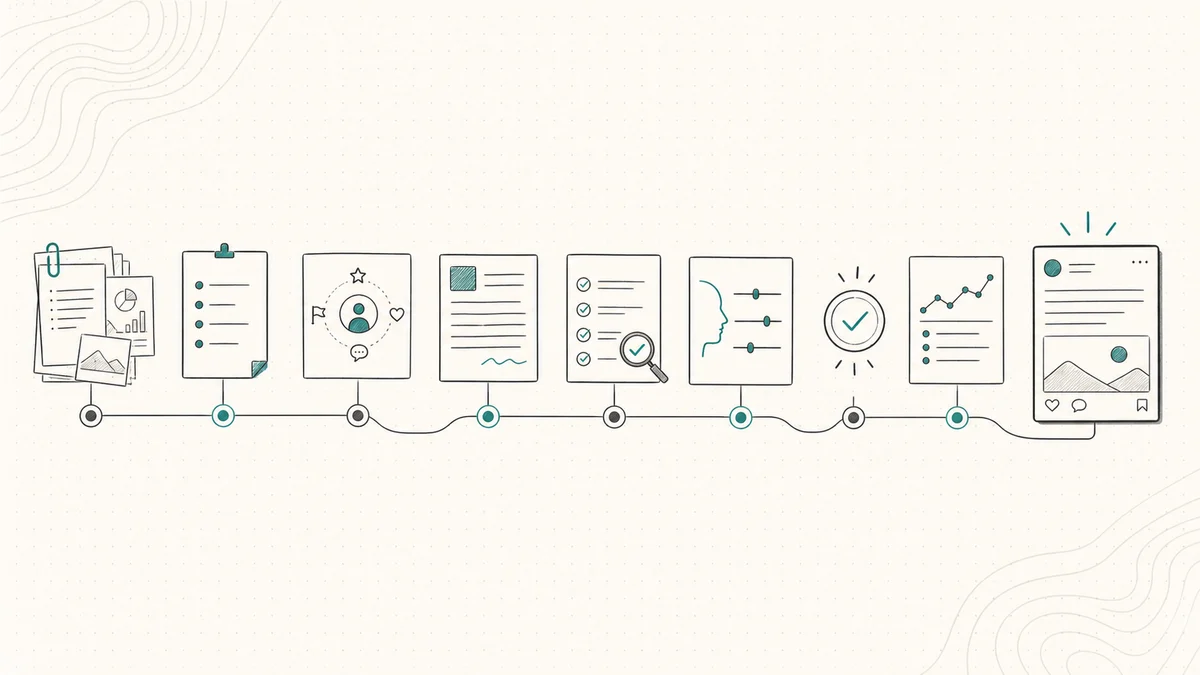
Here is a practical sequence for every post:
- Source: capture the transcript moment, note, story, or approved idea.
- Brief: define the claim, evidence, reader, boundary, and intended action.
- Voice load: open the client's voice card and relevant examples.
- Draft: write the full argument before polishing individual lines.
- Truth review: verify names, claims, examples, confidentiality, and the client's actual position.
- Voice review: check rhythm, vocabulary, emotional range, openings, endings, and avoid rules.
- Client approval: ask focused questions when needed instead of sending a vague "thoughts?"
- Learn: convert meaningful edits into reusable voice or factual rules.
- Publish: format, preview, schedule, and record the final approved version.
You can batch stages without blending voices. For example, collect source material for every client on Monday and schedule approved posts on Friday. But when the work requires inhabiting a voice, draft and review one client at a time.
Step 6: Review the idea and the voice separately
One editing pass cannot reliably answer every question.
Run two passes before sending the draft.
Pass one: Is this the client's post to publish?
- Is the central claim true and consistent with what the client said?
- Is the supporting example real, cleared, and specific enough?
- Does the post protect confidential information?
- Does it contribute to the client's positioning rather than chase a generic trend?
- Is there any sentence the client would need to fact-check or qualify?
- Does the takeaway follow from the argument?
Pass two: Does it sound like this client?
- Does the first line use an opening pattern they would plausibly choose?
- Does the sentence rhythm match strong approved samples?
- Are repeated words and transitions actually theirs?
- Is the emotional intensity inside their normal range?
- Have any phrases from another client slipped in?
- Does the ending sound natural, or has it defaulted to your standard CTA?
- When read aloud, can you hear the client saying the important lines?
Reading aloud matters because your eyes forgive familiar writing habits. Your ear catches the sentence a client would never say.
Step 7: Turn every approval round into system memory
Client edits are not only changes to one post. They are new evidence.
Separate feedback into categories:
On a narrow screen, scroll sideways to read every column.
| Edit type | What to do with it |
|---|---|
| Factual correction | Update the client reference or approved fact bank |
| Voice correction | Add or revise a voice rule with the before-and-after example |
| Positioning change | Update the opinion bank and check planned posts for conflict |
| Personal preference | Record it if repeated; do not overfit to one isolated edit |
| Confidentiality boundary | Add it immediately to the client's permanent avoid list |
| Post-specific choice | Keep it with the draft, not as a universal voice rule |
This prevents the most frustrating approval loop: the client makes the same correction every month because the lesson stayed trapped in an old document.
It also keeps the voice profile alive. People change. A founder becomes more direct after a repositioning. A consultant stops using a phrase that no longer fits. An executive becomes comfortable sharing stronger opinions. The system should follow the person rather than preserve a snapshot from onboarding forever.
Where should AI fit in a LinkedIn ghostwriting workflow?
Use AI where context can be supplied and the result can be reviewed.
It is useful for:
- finding repeated patterns across approved writing samples;
- organizing a voice card from evidence;
- turning a complete idea brief into a first draft;
- producing structurally different versions of the same supported argument;
- checking a draft against explicit voice and avoid rules;
- identifying repeated phrases across several client drafts;
- summarizing approval edits into candidate rules for human confirmation.
It should not be trusted to invent:
- the client's point of view;
- a personal story or customer example;
- results, numbers, quotations, or evidence;
- confidential context the client never supplied;
- a strong claim simply because the post needs a hook.
The useful division of labor is simple: the client supplies experience and judgment, the ghostwriter extracts and shapes it, and the tool reduces the mechanical work of applying a known voice to a supported idea.
That keeps the ghostwriter in the valuable part of the job. You are not being paid to type faster. You are being paid to notice what is worth saying, make it sound true to the person saying it, and know when a clean draft is still wrong.
How WriteHero supports separate client voices
Full disclosure: WriteHero is our product.
The Ghostwriter plan is built around one voice profile per client. Each profile learns from that client's real LinkedIn posts and remains separate from the rest of the roster. You choose the client, start from an idea or saved inspiration, and generate a draft against that voice instead of rebuilding the context in a shared chat.
It does not replace the extraction call, the client's point of view, or your final judgment. It automates the voice-loading and first-draft part of the workflow described above.
The Ghostwriter plan supports up to 10 voice profiles. See current pricing for the monthly and full-year bill, currency and tax; annual billing is not month to month. There is no card required to start the fourteen-day trial, so the trial ends unless you actively choose a paid plan.
Create your first client voice
A compact weekly workflow for a five-client roster
The exact calendar should fit your client commitments, but the work can follow a stable shape.
On a narrow screen, scroll sideways to read every column.
| When | Stage | Rule that protects voice |
|---|---|---|
| Monday | Gather calls, notes, and approved ideas | File each source directly into its client workspace |
| Tuesday | Build idea briefs | Finish the claim and evidence before writing hooks |
| Wednesday | Draft | Work one client at a time and reset context between them |
| Thursday | Truth and voice review | Use two passes; compare against approved examples |
| Friday | Approval, scheduling, and learning | Convert recurring edits into rules before closing the task |
The point is not that Wednesday must be drafting day. The point is that every post moves through the same gates, while every client's evidence and voice stay isolated.
How do you know the system is working?
Do not measure voice quality only by whether a draft was approved. A busy client may approve something that is merely acceptable.
Track signals that reveal whether the workflow is improving:
- fewer repeated voice corrections from the same client;
- fewer phrases shared accidentally across clients;
- more first drafts that survive the read-aloud check;
- clearer, more specific client feedback when a draft misses;
- a growing library of approved examples and reusable rules;
- less time spent reconstructing context before each draft;
- confidence that another writer could use the system without flattening the voice.
The strongest test is simple. Remove the name and profile photo from several approved drafts. Can you still tell which client each one belongs to?
If not, the answer is not more dramatic hooks or a longer style guide. Return to the evidence. Find the differences in how each client thinks, explains, argues, and reacts. Then make those differences structural in the workflow.
Keep the system consistent so the people can stay distinct
Scaling a ghostwriting roster does not require one giant brain capable of remembering every phrase, story, and preference at once.
It requires a reliable system that puts the right person's context in front of you at the right moment.
Keep the source material separate. Capture observable voice choices. Extract the real claim before drafting. Review truth and voice independently. Turn approvals into memory.
The workflow should repeat.
The voices should not.
Related reading
- How to write a LinkedIn post: structure one useful post without flattening the writer's voice.
- LinkedIn post generator: what to expect from drafting tools and how voice profiles differ from tone selectors.
- LinkedIn content strategy: connect positioning, content pillars, rhythm, and voice.
- LinkedIn post ideas: turn client moments and opinions into specific starting points.
- Best AI tools for LinkedIn posts: compare tools by the job they solve rather than feature count.
- WriteHero for ghostwriters: keep a separate voice profile for every client.
Choose your next step
Frequently asked questions
What is LinkedIn ghostwriting?
LinkedIn ghostwriting is writing posts for another person to publish under their own name. A LinkedIn ghostwriter extracts the client's ideas, stories, and positions, then shapes them into posts that reflect how the client naturally thinks and communicates. The job includes research, voice capture, drafting, factual review, approval, and learning from the client's edits.
How do LinkedIn ghostwriters manage multiple clients?
Use a separate workspace and voice reference for every client, then move each post through the same stages: source material, idea, draft, voice review, client approval, and revision capture. Work on one client's voice at a time, even if you batch the same stage across the week. The system should make the correct context visible before you write instead of relying on memory.
What is voice bleed in ghostwriting?
Voice bleed happens when language, rhythm, opinions, or post structures from one client appear in another client's work. It usually starts subtly: the same hooks, sentence lengths, favorite transitions, or calls to action show up across a roster. Over time, every client begins to sound like the ghostwriter's house style rather than a distinct person.
How do you capture a client's writing voice?
Study real material from the client, including past posts, call transcripts, emails, and approved edits. Document observable patterns such as sentence shape, vocabulary, emotional range, recurring arguments, phrases they use, phrases they reject, and strong on-voice examples. Avoid vague labels like professional or authentic because they do not tell a writer what to do.
How many writing samples do you need for a client voice guide?
There is no universal number. Use enough representative material to find repeated patterns rather than one-off quirks. Prioritize recent posts the client still identifies with, include different post types, and confirm uncertain patterns during onboarding. A small set of relevant samples is more useful than a large archive of outdated or ghostwritten material.
Can AI keep different ghostwriting clients' voices separate?
It can help when each client has isolated source material, examples, constraints, and a separate voice profile. A single generic prompt or shared chat tends to pull drafts toward one average style. Human judgment is still required for the client's point of view, factual accuracy, confidential context, and the final voice check.
What should a LinkedIn ghostwriter check before sending a draft?
Check the idea and the voice separately. First confirm that the post is true, useful, aligned with the client's position, and supported by real source material. Then read it aloud and check sentence rhythm, vocabulary, emotional range, recurring structures, forbidden phrases, and whether the client would plausibly say the central claim.
Related guides
Browse Writing
See your first post, in your voice
Paste your LinkedIn profile and WriteHero drafts a post that sounds like you. See it before you sign up, no login needed. Create an account later to save the draft.